

Throughout my career, I have never heard a business owner say, “Let’s spend more money, but do it properly.” Almost every second client asks about the price first. Only after that do they ask how the system actually works. And honestly, I don’t blame them. It’s a natural reaction. When you’re building a warehouse, opening a production facility, or renovating an office, the list of expenses seems endless. But after the first serious fire, the conversation changes completely.
I still remember a project in Brovary. It was a polymer packaging warehouse covering roughly 1,800 square meters. We arrived there after a nighttime fire to find out why the protection system had failed. The owner was convinced that everything necessary was already in place. There were fire extinguishers. Fire hose cabinets were installed. Even the fire alarm had worked exactly as it should. But once we started looking into it, the real problem became obvious: fixed fire suppression systems had never been installed. They had been removed from the budget during construction because, as someone put it, “we can always add them later.” They never did. The fire spread in less than nine minutes. By the time firefighters arrived, the temperature inside was already high enough to deform the steel storage racks. In the end, the business lost equipment, inventory, and part of the roof. They had saved money during construction but ended up losing several times more.
Here’s the thing. People often confuse portable fire extinguishing equipment with permanent fire protection systems. On the surface, both are designed to fight fire, so the confusion seems understandable. In reality, they serve very different purposes.
What Fixed Fire Suppression Systems Really Are
People sometimes ask me what fire suppression actually means. My answer is always simple. It isn’t a single device or one specific technology. It’s a combination of equipment and engineering solutions designed to stop a fire before it grows beyond control.
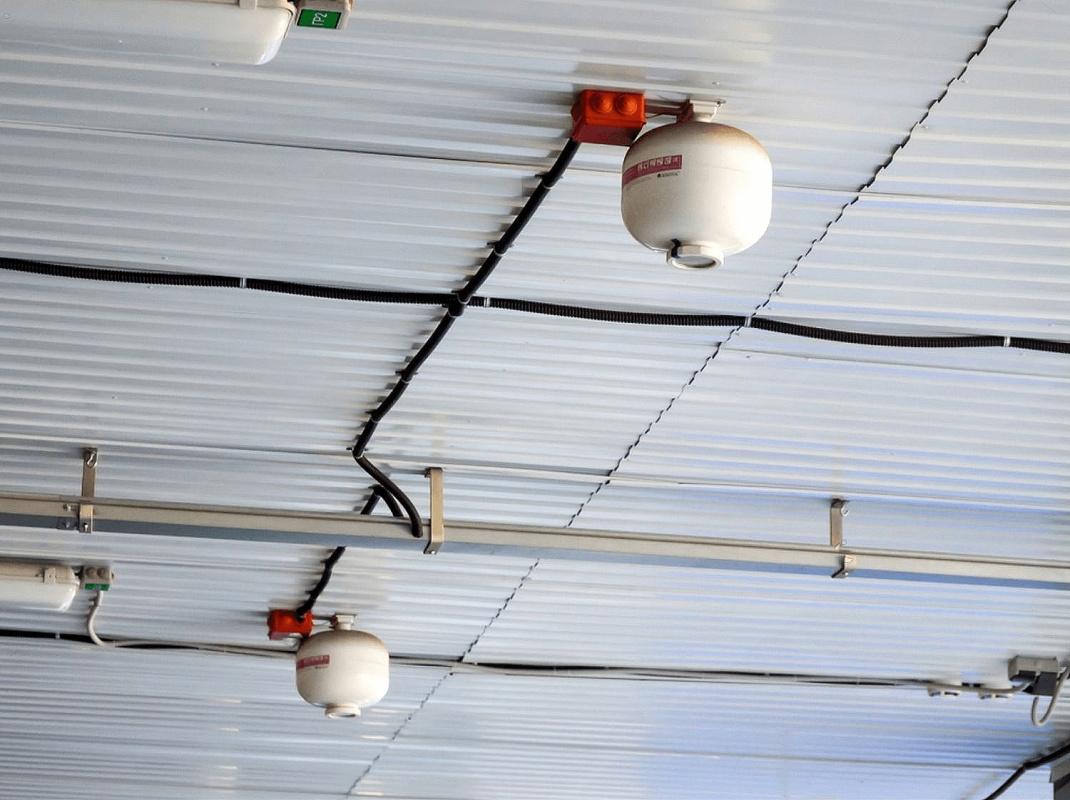
That is exactly why fixed fire suppression systems are permanently installed inside a building. They do not wait for someone to grab a fire extinguisher. They do not rely on an employee staying calm under pressure. Human intervention is kept to a minimum—although, to be fair, some systems can still be activated manually or operate in a combined automatic/manual mode.
By the way, the word “autonomous” often creates confusion. Many people assume every system works completely on its own. In practice, it depends on the facility. A small suppression module may indeed operate independently. A large industrial site works differently. Once a fire alarm is triggered, ventilation shuts down, smoke extraction starts, dampers open, and notifications are sent to the control room. I've tested sequences like these during commissioning. Sometimes a single verification cycle took twenty minutes because every component had to respond exactly as designed.
One lesson has stayed with me over the years. Whenever someone suggests “simplifying” a project, I remember a manufacturing facility where the customer decided to replace the specified fire pump with a cheaper model. On paper, the difference looked insignificant. During acceptance testing, however, it became obvious that the system could no longer maintain the required pressure. One of the installers joked that the cheapest pump had become the most expensive piece of equipment on the entire project.
Why Automatic Fire Suppression Systems Protect More Than Property
Many people still see automatic fire suppression systems as little more than a regulatory requirement. They assume the systems exist simply because the building cannot be commissioned without them. That is only part of the story.
There was a month when I visited two completely different sites. First, a small server room where everyone was worried about protecting expensive electronics. A week later, I was inspecting a furniture factory where the main hazards were sawdust and flammable coatings. The solutions were completely different, but the objective remained the same: prevent the fire from winning those first critical minutes, when the situation is still manageable. Those are the minutes that can save a building, expensive equipment, and sometimes even lives.
What happens when that protection isn't there? No dramatic stories—just facts.
At one furniture manufacturing plant, a faulty power supply inside a machine caused a fire. CCTV footage showed the first flames at 2:17 p.m. Three minutes later, sawdust inside the extraction duct ignited. Seven minutes after the initial ignition, the fire had already spread into the adjacent production area. Employees discharged three fire extinguishers, but it wasn't enough. Had an automatic fire suppression system been installed, the fire would most likely have been contained during those first few minutes.