

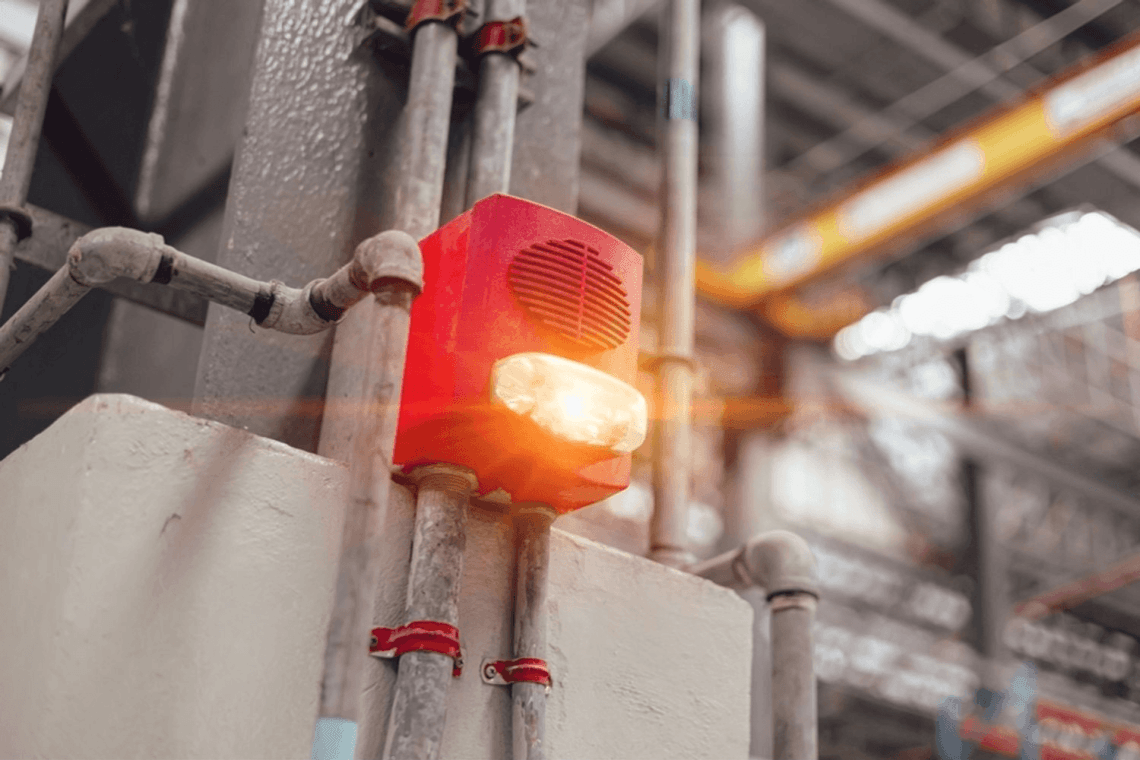
I manage a department that reviews contractors' work after installation, checking everything before it is handed over to the client. And honestly, the difference between "the system works" and "the system is installed properly" is a gap most customers do not even realize exists.
One project involved a cleaning company, with a small office and a warehouse used to store materials. The contractor completed the work, everything was connected, and the tests were successfully passed. Then, while reviewing the documentation, I noticed that the cable in the warehouse had been routed directly across the storage racks without any fastening. It was held in place solely by its own weight and friction against the metal shelving. It would work. Probably for a couple of months, until someone accidentally caught it while loading goods.
On that project, fire alarm installation and fire safety compliance were treated as two separate tasks when they should have been considered a single integrated process. The system was installed, but nobody took the time to think about how it would interact with the real conditions of the warehouse, the shelving, daily operations, and the people working there.
High-Quality Fire Alarm Installation: Details Only a Careful Eye Notices
High-quality fire alarm installation is made up of dozens of small details, each of which may seem insignificant on its own. Cable trunking instead of exposed cable. Circuit labeling that actually matches the documentation rather than being marked "approximately." Detectors positioned at a sufficient distance from air vents so that airflow does not interfere with proper detection.
The cost of fire alarm installation is largely determined by these details, not only by the price of the equipment itself. Quality installation costs more because it requires time for proper mounting, correct cable routing, and testing each individual component rather than performing only a general system test at the end. Low-cost proposals often skip these steps altogether, and the customer usually does not discover that immediately.
Ask your contractor to provide progress photographs during installation, before cable routes are concealed behind ceilings or enclosures. Once the work is completed, physically verifying the quality of cable installation may no longer be possible because everything is hidden from view.
Fire Safety in the Office Exists Independently of the Alarm System
Fire safety in an office is not simply about having a technical system in place. It depends on how people use the premises every day. I once inspected a facility where the alarm system was excellent and the installation quality was flawless, yet the evacuation corridor was filled with boxes of promotional materials because storage space had run out and the boxes had been placed there "for a couple of weeks." As usual, those couple of weeks turned into an indefinite period.
The most common cause of office fire safety problems is not technical failure but ordinary human negligence accumulated over time. Emergency exit doors held partially open with improvised objects because of drafts. A fire extinguisher hidden behind archive boxes because it was considered inconveniently placed. Small issues that individually seem harmless but together create serious risks.
Lightning Protection Systems: The Item Often Added Last to the Budget
A lightning protection system is usually included in a project at the very end, after the primary budget has already been approved. By that stage, it receives the least attention and often the least funding. In reality, the opposite approach would make more sense, especially for facilities located in open areas or for standalone warehouse buildings with no neighboring high-rise structures that could intercept a lightning strike.
Most people only remember lightning protection after an incident has already occurred, when equipment has failed following a thunderstorm or electrical wiring has been damaged by induced currents. It is far less expensive to include lightning protection from the beginning as part of the overall safety strategy than to arrange emergency repairs after real damage has already been done and the focus has shifted from prevention to restoring business operations.