

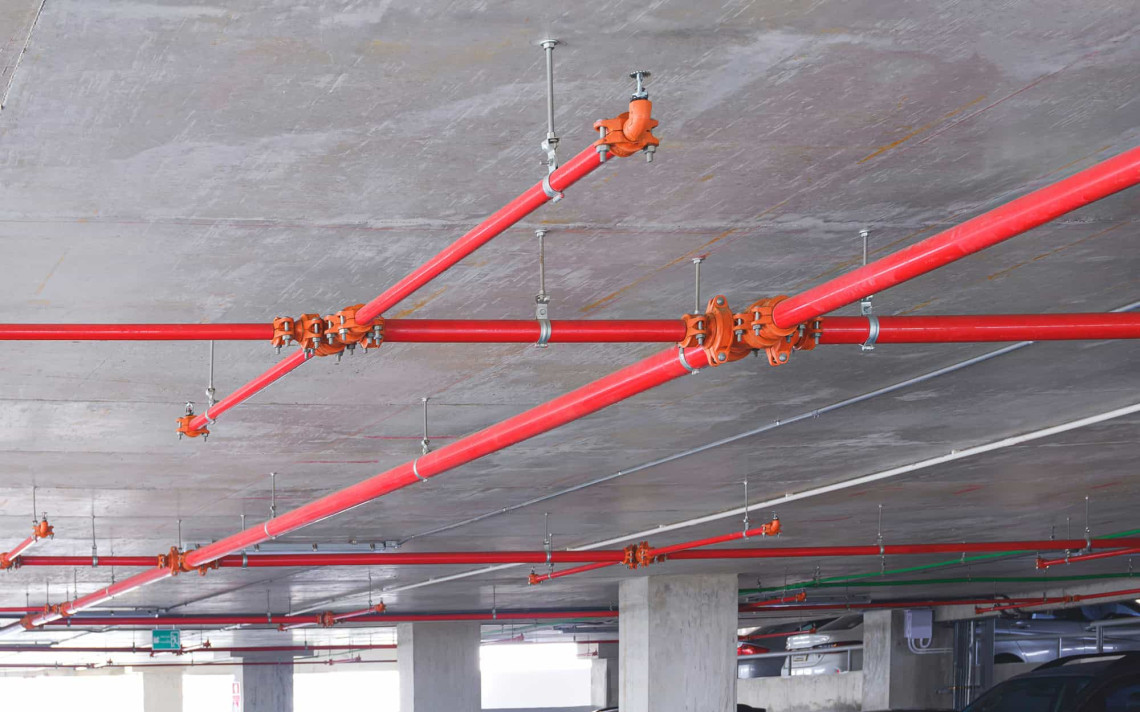
When a client calls for the first time and asks "so how much does fire protection cost for our site," I always ask back — what exactly do they mean. Because behind that question could be a smoke detector worth a few dollars, or a full-scale project running into six figures. The difference is significant, which is why it's worth sorting out the terminology first, before talking numbers.
A Fire Protection System Is Not One Device — It's a Complex
Put simply — a fire protection system is a set of technical solutions, equipment, and engineering measures that detect a fire at an early stage, alert people, and ideally extinguish or contain the flames before the fire service arrives. This isn't just about alarms. It includes smoke extraction, automatic fire suppression, fire dampers on ventilation systems, and emergency lighting that kicks in when main power goes out.
In practice, clients often confuse "fire alarm" with "fire protection system." The alarm is only one part, though a critical one. It detects and notifies. Protecting a building goes further than that — whether the automation actually triggers, whether the structural elements hold up, whether there are evacuation routes people can physically use without smoke in their eyes.
Fire Protection and Fire Alarm Systems — Where's the Line
A fire alarm detects smoke or a rise in temperature and sends a signal to the panel or dispatcher. From there, different logic kicks in. Automatic fire protection systems — sprinkler installations or gas suppression, for example — respond to that signal on their own, without human involvement. That matters especially for server rooms, archives, and chemical storage — places where you can't use water, or where a person simply won't get there with an extinguisher in time.
We had a project in Kyiv once — a small cosmetics warehouse. Incidentally, a fire protection system in Kyiv for warehouse spaces often runs into dense urban development and aging utilities, so a standard design rarely fits without adjustments. The owner initially wanted to get by with just an alarm and a few extinguishers.
Fire Protection System Requirements — Where They Come From
It all depends on the building's category, floor area, number of stories, and purpose. An office center, a retail space, a warehouse holding combustible materials — each has its own set of standards. The building code specifies exactly which measures are mandatory: detector types, whether automatic suppression is required, evacuation exit width, fire resistance of structural elements. That's exactly why designing fire protection systems isn't something you eyeball. A designer accounts for the real fire load of a space — how much and what kind of combustible material is stored or used there, how many people are typically inside at once, what evacuation routes actually exist physically. Skip that calculation, and any solution ends up either overbuilt (and needlessly expensive) or inadequate — and that's a matter of people's safety, not just money.
Ten years or so ago, plenty of sites got by with a minimal package — an alarm and a handful of extinguishers, and that was enough to pass inspection. Requirements now are considerably stricter, especially for shopping centers, venues with high occupancy, and warehouse complexes. Inspectors don't just look at paperwork anymore — they check whether the equipment actually works during testing.
Fire Protection Systems for Buildings: What's Included
For a typical building — office or industrial — the package usually looks like this:
- addressable fire alarm with signal output to a monitoring station;
- notification and evacuation control system — audible, sometimes voice-based;
- automatic fire suppression where required by code (server rooms, archives, parking garages);
- smoke control ventilation and dampers that stop smoke from spreading through shafts and corridors;
- emergency lighting along evacuation routes.
Fire protection systems for business and residential use differ in scale, but the logic is the same. A private house usually just needs standalone smoke detectors and, if desired, a basic notification system. A business center or production facility needs a full project with approvals, installation, and ongoing maintenance of the fire protection system — because equipment that isn't checked regularly gradually stops working properly. A detector that hasn't been tested in a year might simply fail to trigger when it matters — and unfortunately, that's usually discovered after the fact.
Fire Protection System Cost — and Why It Varies So Much
This is where most of the questions come in. The cost of a fire protection system is made up of several components: design, equipment, installation, commissioning, and ongoing maintenance. For a small office of 200-300 square meters, a minimal package with an alarm and notification system can come in at a modest price. For a warehouse with automatic gas suppression, the number jumps considerably — the suppression equipment and extinguishing agent cylinders alone cost far more than standard smoke detectors. Cost is also affected by equipment brand, installation complexity (an old building with thick walls always takes longer and costs more than a new build with open utility runs), and urgency. If it's needed "yesterday," you'll pay extra for expedited delivery.
So when someone asks about fire protection system cost per square meter, the honest answer is: without a technical brief and a site visit, you can't name an exact figure. A ballpark range — sure, that's doable. But an accurate estimate only comes after the design phase, once it's clear how many detectors are needed, how long the cable runs are, and whether suppression is required and of what type.
Fire Protection System Technical Solutions — A Few Practical Notes
Over the past few years, addressable-analog systems have become noticeably more popular than conventional threshold-based ones. The difference is that an addressable system pinpoints the exact trigger location — not just "floor 3, zone A," but a specific device. For large facilities, that saves response time, and in fire safety, time is essentially everything. Fire alarms are also increasingly integrated with access control and ventilation systems — when a detector triggers, doors unlock automatically for evacuation, and ventilation switches into smoke-extraction mode. These used to be separate, unconnected systems, and staff had to manually open emergency exits themselves. Now automation handles it in seconds, without human involvement, which is exactly what saves lives in critical moments.
If there's one practical takeaway — don't start with "how much does it cost." Start with a technical brief and your building's category. Then the price becomes transparent, and the system actually works, instead of just hanging on the wall as a checkbox for the next inspection.