

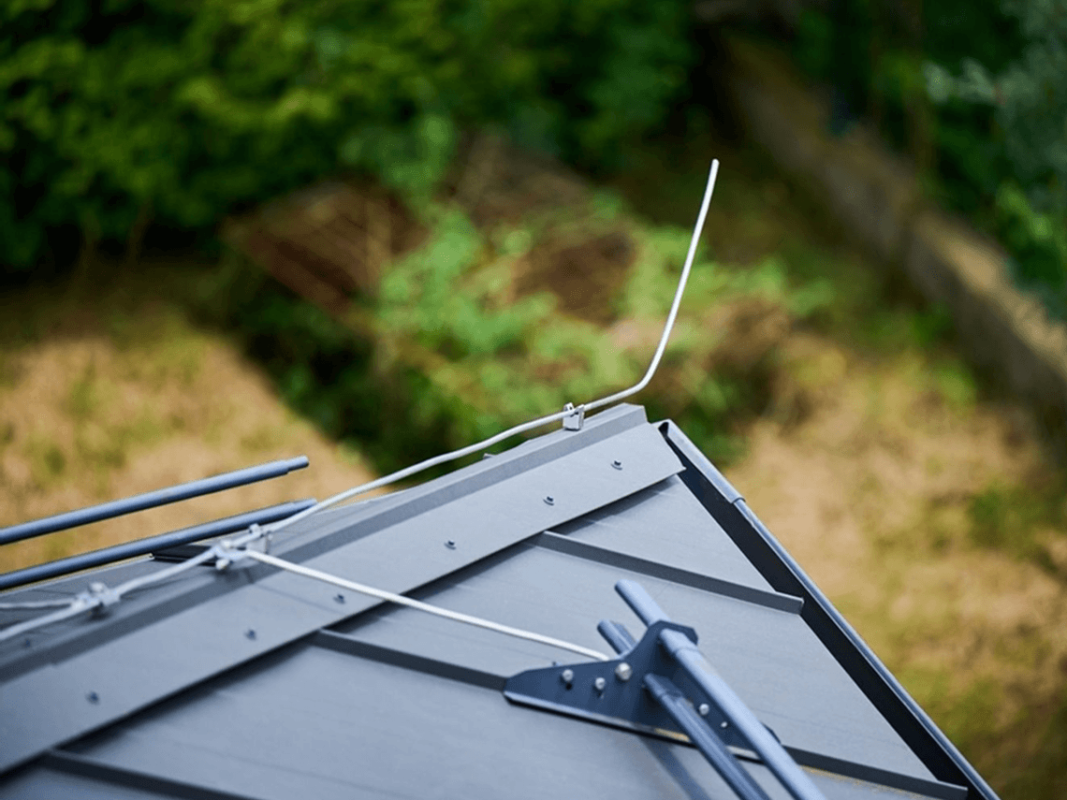
For fourteen years I have been installing lightning protection and electrical measurements at facilities - from private houses to industrial workshops. The topic seems boring until you see what happens when it is ignored.
I'll start with a case. There was a facility in Brovary, a metal structure warehouse, a roof - forty meters wide, metal everywhere. The owner decided that the lightning rod was "for insurance, but in reality no one needs it." He saved money. Two years later - a direct hit to the roof, a section of the cable route burned out, production stopped for four days. By the way, the insurance company initially refused to pay - they found a formal reason. This is how the "savings" turned out to be the amount for which the system could have been made three times.
When looking for a lightning protection system price in Kyiv - what to really look for
I am often asked something in the form of a lightning protection system price in Kyiv, also with the prefix "only fast and inexpensive" - because here, to be honest, the market is very diverse. One company counts only metal and work, another - also a project, coordination, a certificate of measurements of grounding resistance. The difference in the end can be twice, and sometimes more, and the client looks at it as "who is cheaper", although in reality he is comparing incompatible offers.
Although, again, a cheap offer is not always bad. I have seen objects where the minimum estimate gave a working, reliable system - just without excess. And I've seen the opposite: an expensive project with a good presentation, and on the site the grounding conductor is driven in 40 centimeters instead of one and a half meters, because "the soil is rocky, it couldn't go deeper." No one checked the resistance after installation. That's where the real difference is, not in the color of the folder with documents.
A lightning protection system in Kyiv and a system somewhere in a village near Chernihiv may technically differ slightly. But the quality control of the installation is where half of the cost, which you pay or don't pay, actually lies.
Lightning protection security systems - and what is often confused between them
And here the question arises - is lightning protection at all a part of the security systems of the site, or is it a separate story? Formally - separate, prescribed in the standards independently. In reality, in practice, the very concept of a lightning protection security system immediately includes grounding, because everything at the facility works as one ecosystem: without normal grounding, lightning protection is ineffective, and signaling and video surveillance are vulnerable to induced surges during a lightning discharge, even nearby, not necessarily a direct strike.
There was a case when three cameras and a recorder "flew" at a facility in Irpin after a thunderstorm - lightning struck a tree a hundred meters away, the induced voltage passed through the cable network. There was a lightning rod on the building, and it worked as it should. It's just that no one thought about protecting signal lines.
Measuring insulation resistance with a megger is something that cannot be done "by eye"
What if you just look at the cable and understand whether it is working? No, that doesn't happen. Measuring insulation resistance with a megohmmeter remains the only way to see what is happening inside the wiring, where the eye cannot reach. The norm for most networks is at least 0.5 MΩ, and here's the thing: the cable may look perfect on the outside, but inside it has gained moisture even at the stage of laying in a wet trench. A list of things that I always record in the measurement protocol, and not just "by ear":
- insulation resistance of each phase relative to the ground and between phases;
- temperature and humidity during measurement (they affect the result more than you think);
- the condition of connections in junction boxes is often the reason for the low resistance there.
After all, both lightning protection and electrical measurement are not about papers for inspection bodies, although formally everything is often done for their sake. It's about a building that will stand after a thunderstorm, and not burn down because of a cable that "supposedly was in good condition." Sounds simple. Until I held a megger in my hands during the rain, when I had to catch up with the next storm cloud.